ASL Meaning in Text: A Complete Guide to Understanding This Popular Slang
In today’s fast-paced digital world, texting slang has become a language of its own. One abbreviation that continues to pop up in chats, social media, and online conversations is ASL. While it may seem simple, ASL can have multiple meanings depending on the context in which it is used.
Understanding what ASL meaning in text is essential for smooth communication, especially when interacting with people online. Whether you’re chatting on social media, gaming platforms, or messaging apps, knowing how to interpret ASL can help you avoid confusion and respond appropriately.
What Does ASL Meaning in Text?
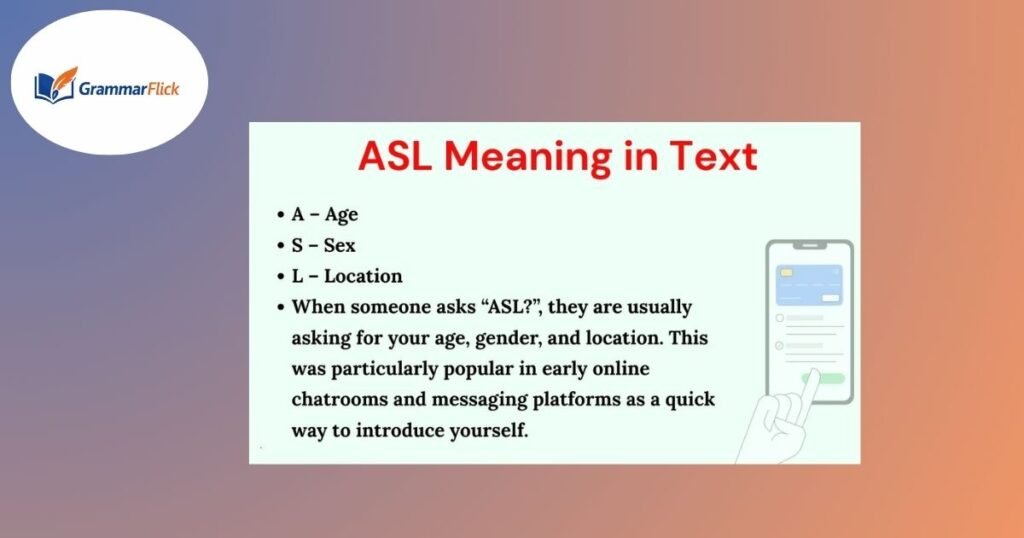
ASL most commonly stands for Age, Sex, Location. It is a shorthand used to ask someone basic personal information, typically at the start of a chat or online interaction. This abbreviation allows users to quickly understand who they are talking to without lengthy introductions.
Although it originated in early internet chat rooms, ASL is still recognizable in modern texting, social media, and gaming platforms. Depending on context, it can also mean other things like American Sign Language or even “as hell,” but when used as a question, it almost always refers to Age, Sex, and Location
The Origin of ASL in Online Communication
ASL emerged during the early days of internet chatting, particularly on platforms like AOL Instant Messenger, Yahoo Chat, and IRC. At that time, users often interacted with strangers in real-time, and efficiency was key. Typing out full sentences was slower, so abbreviations like ASL helped users gather essential information quickly.
It became a standard way to introduce oneself and initiate conversations online. Over time, it also became a cultural staple of internet communication, remembered fondly by those who grew up in the chat room era, and continues to appear in casual online exchanges
Different Meanings of ASL in Text
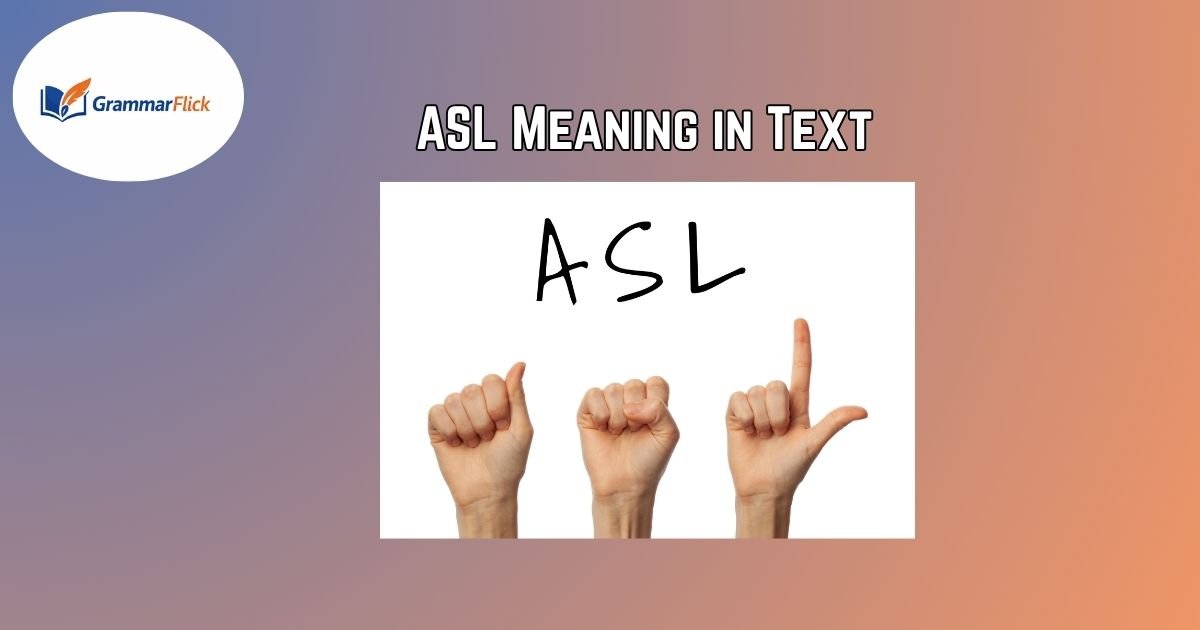
While Age, Sex, Location is the most widely recognized meaning of ASL, the abbreviation can have other interpretations depending on context. It can refer to American Sign Language, used by the deaf and hard-of-hearing community.
In casual texting, particularly among younger audiences, it may also mean “as hell”, for example, “tired ASL” to express strong emphasis. Recognizing the correct meaning requires attention to the conversation topic, sentence structure, and tone. This versatility demonstrates how internet slang can evolve and carry multiple meanings, making context crucial when interpreting ASL.
How to Identify the Correct Meaning of ASL
Identifying the correct meaning of ASL in a conversation relies heavily on context. If ASL appears as a standalone question like “ASL?”, it almost always refers to Age, Sex, and Location. If it’s part of a sentence discussing language or learning, it likely means American Sign Language.
In casual or emphatic texting, such as “hungry ASL,” it could mean “as hell.” Paying attention to the tone, sentence structure, and the platform where the conversation occurs helps determine the intended meaning. Observing how the person uses ASL in previous messages can also provide clarity.
Examples of ASL in Text Conversations
ASL can appear in different contexts with distinct meanings. For instance, in a chat room:
- Person 1: “Hey!”
- Person 2: “Hi, ASL?”
- Person 1: “22, male, USA”
- Here, it clearly asks for Age, Sex, and Location. In casual texting, it may be used like:
- “This game is hard ASL.”
- Here, ASL emphasizes intensity, meaning “as hell.” In educational contexts:
- “I’m taking ASL classes this semester.”
Why People Still Use ASL Today
People continue to use ASL today because it is quick, familiar, and culturally recognizable. It offers a fast way to start conversations, especially on anonymous platforms where personal information isn’t immediately visible.
Some users employ it out of nostalgia, recalling the early days of chat rooms and instant messaging. casual slang trends, like using ASL to mean “as hell,” keep it relevant among younger audiences. Its versatility and brevity ensure that ASL remains part of online communication, even as digital platforms evolve and new abbreviations emerge.
Is It Safe to Respond to ASL?
Responding to ASL can be safe, but it requires caution. Since ASL often asks for personal details like age, sex, and location, sharing this information with strangers online can pose privacy risks. On anonymous platforms or public chat rooms, it’s wise to avoid giving exact details.
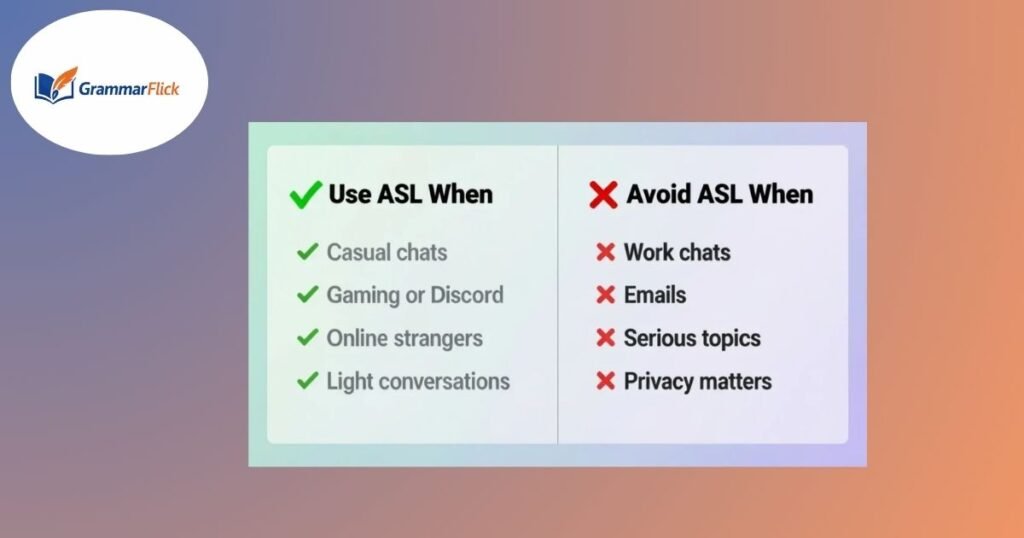
Instead, you can respond vaguely or skip answering entirely if you feel uncomfortable. Assess the trustworthiness of the person and the platform before sharing personal information. Using discretion ensures your safety while still allowing casual online interactions.
Modern Alternatives to ASL
- How old are you?
- What’s your age?
- Where are you from?
- Where do you live?
- What city are you in?
- What country do you live in?
- Are you male or female?
- What’s your gender?
- Can you tell me about yourself?
- Mind sharing your location?
- How old is everyone here?
- What’s your hometown?
- What’s your place of residence?
- Can I know your age?
- What’s your demographic info?
- Where do you call home?
- Are you a guy or a girl?
- Tell me a bit about yourself.
- Where do you currently stay?
- Could you share some info about you?
ASL in Social Media and Messaging Apps
ASL continues to appear across various social media platforms and messaging apps, though its usage has evolved over time. On apps like Snapchat and Instagram, users might still ask “ASL?” when chatting with new people, especially in direct messages.
In online gaming or multiplayer platforms, ASL is sometimes used to quickly identify players’ age, gender, or location. Many platforms now encourage profile-based introductions, reducing the need for ASL. Despite this, its familiarity and brevity keep it relevant in casual, fast-paced, or anonymous conversations where quick introductions are preferred.
Read More: ICL Meaning in Text: A Complete Guide to This Popular Slang
Cultural Impact of ASL
ASL reflects the adaptability and creativity of online language. It demonstrates how internet users develop shorthand communication to save time and streamline conversations. Beyond its practical function, ASL has become a cultural marker of early internet and chat room eras, remembered nostalgically by users who grew up with instant messaging.
Its multiple meanings Age, Sex, Location; American Sign Language; and “as hell” show how slang can evolve with changing trends and audiences. ASL has influenced the way digital shorthand develops, inspiring countless other abbreviations that dominate online conversations today
Common Misunderstandings About ASL
ASL is often misunderstood because of its multiple meanings and changing context. Many assume it always refers to Age, Sex, Location, even when the conversation clearly involves learning a language or casual slang. Some may confuse it with American Sign Language, especially in educational or professional settings.
The “as hell” usage can be misinterpreted by those unfamiliar with modern texting conventions. These misunderstandings highlight the importance of context, tone, and platform when interpreting ASL to ensure accurate communication.
Final Words
ASL is a versatile and widely recognized abbreviation in online communication. Most commonly, it stands for Age, Sex, Location, used to quickly gather basic personal information in chats, social media, and gaming platforms.
Its meaning can shift depending on context, also representing American Sign Language or the slang phrase “as hell.” Understanding ASL requires attention to sentence structure, tone, and platform. While its usage has evolved over the years, it remains a notable part of internet culture, demonstrating how language adapts to the fast-paced digital world and casual online interactions.
FAQs
What Does ASL Mean When Someone Texts me “ASL?”
When used as a question, “ASL?” almost always stands for Age, Sex, Location. The person is typically trying to get basic information about you in a casual conversation, online chat, or gaming platform.
Can ASL Have Other Meanings Besides Age, Sex, Location?
Yes. Depending on context, ASL can also mean American Sign Language in educational or professional discussions, or “as hell” in casual texting for emphasis. Context, sentence structure, and tone are key to understanding its intended meaning.