Well Deserve or Well Deserved: Which One Is Grammatically Correct?
Choosing between well deserve or well deserved can be confusing, especially because both phrases appear online so often. While they may sound similar, only one is grammatically correct in most everyday situations. The confusion usually comes from misunderstanding verb forms and how English uses past participles as adjectives.
If you want your writing to sound natural, professional, and error-free, knowing the difference matters. In this guide, we’ll clearly explain which phrase is correct, why it works, and when the other form is rarely acceptable. By the end, you’ll confidently use the right expression every time.
Understanding the Core Confusion Of Well Deserve or Well Deserved
The core confusion between well deserve and well deserved comes from verb tense and sentence structure. Many people assume adding the adverb well allows the base verb deserve to stay unchanged, which isn’t true.
English requires the past participle deserved when describing something that has already been earned. Because both forms appear in casual speech and online writing, the incorrect version spreads easily, making it harder for learners to spot the grammatical difference.
The Correct Phrase: Well Deserved
Well deserved is the correct phrase in most situations because it uses the past participle of the verb deserve. English commonly relies on past participles to describe rewards, praise, or outcomes that have already been earned.
When paired with the adverb well, the phrase clearly shows that recognition or success is fully justified. This is why expressions like well-deserved praise, well-deserved rest, and well-deserved success sound natural and grammatically correct in both formal and everyday writing.
Well Deserved: Meaning and Usage
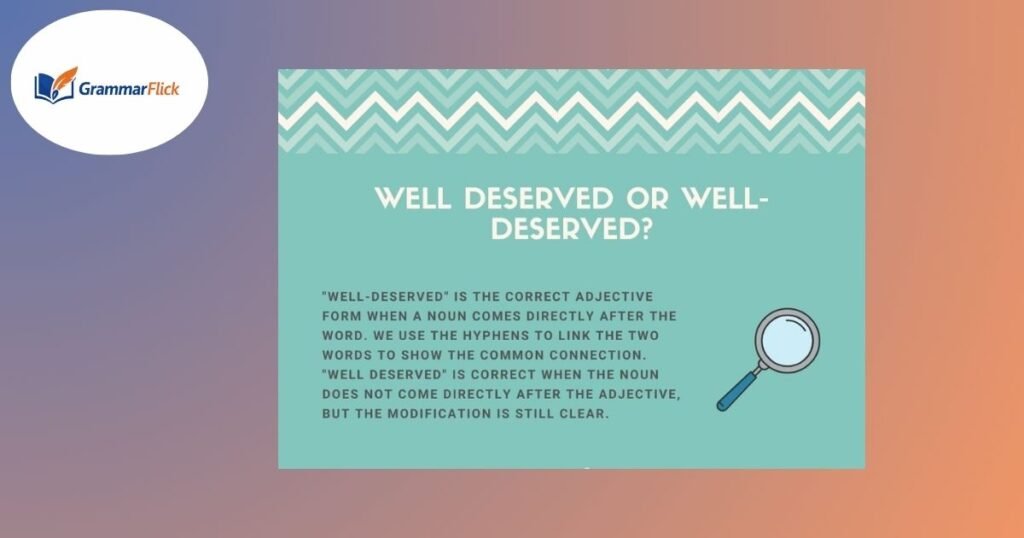
Well deserved means something has been earned fairly through effort, skill, or good behavior. It is used to describe rewards, praise, rest, or recognition that genuinely reflect someone’s actions. In English, it functions as an adjective phrase, which is why it commonly appears before nouns. You’ll often see it in phrases like well deserved promotion, well deserved respect, or well-deserved break. Because it sounds natural and fits standard grammar rules, well deserved is widely accepted in professional, academic, and casual writing.
Examples of Using Well Deserved in A Sentence
- She finally received a well deserved promotion after years of hard work.
- The team enjoyed a well-deserved victory at the end of the season.
- Take a well deserved break and recharge your energy.
- His success is well deserved, given his dedication.
- The actor earned well-deserved praise for the powerful performance.
- After months of training, her medal was well deserved.
- They celebrated their well-deserved achievement together.
- The teacher gained well-deserved respect from her students.
- His reputation as a leader is well deserved.
- The vacation felt truly well deserved after a stressful year.
Is Well Deserve Ever Correct?
Yes, well deserve can be grammatically correct, but only in specific sentence structures. It is used as a present-tense verb phrase and must follow a subject, such as I, you, they, or we. For example, “You well deserve the recognition” is grammatically valid, though it sounds formal and is rarely used in everyday English. In most modern writing and speech, native speakers prefer simpler constructions like you deserve it or the adjective phrase well deserved.
Well Deserved as an Adjective Phrase
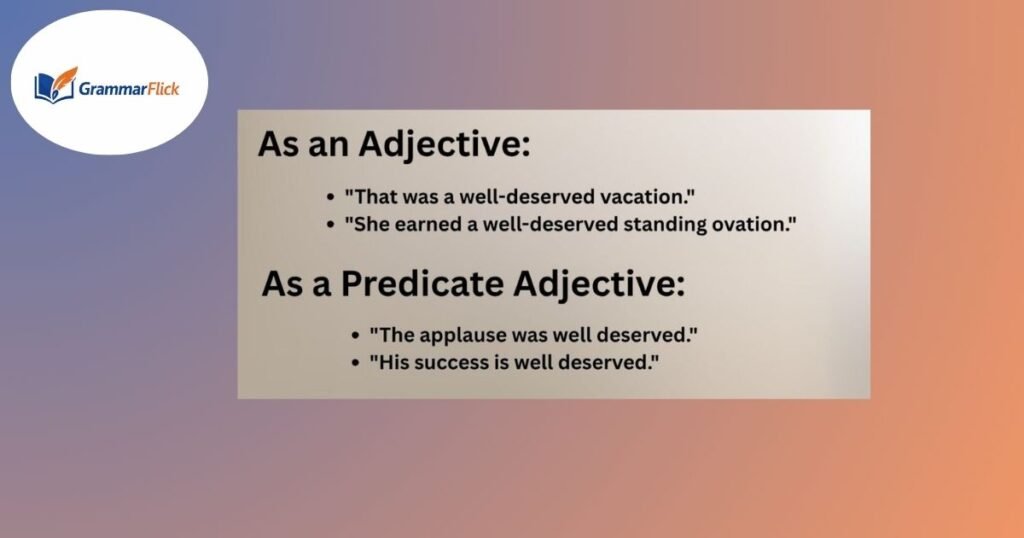
Well-deserved works as an adjective phrase because it describes a noun rather than acting. In English, past participles are commonly used as adjectives to show completed effort or earned results.
This is why phrases like well-deserved praise, well-deserved award, and well-deserved recognition are grammatically correct. Using well-deserved before a noun makes sentences sound natural, polished, and clear, which is why it’s preferred in professional, academic, and everyday writing.
Well Deserved vs Well Deserve in Spoken English
In spoken English, grammar rules are often relaxed, which is why some people casually say well deserved. This usage usually sounds awkward or overly formal to native speakers. Well-deserved is far more common because it flows naturally and clearly expresses that something has already been earned. In everyday conversation, phrases like that praise is well deserved or you earned a well-deserved break feel smooth and familiar, making well deserved the preferred choice in speech.
Why Native Speakers Prefer Well Deserved
Native speakers prefer well-deserved because it follows natural English patterns and sounds fluent in both writing and speech. The past participle form works perfectly as an adjective to describe nouns like praise, success, or rest, making sentences clear and precise.
Using well deserve in similar contexts often feels awkward or incorrect. Over time, patterns like well-deserved recognition or well-deserved reward have become standard, which is why native speakers instinctively choose well-deserved for correctness and natural flow.
How to Remember the Difference Easily
A simple way to remember the difference is to focus on tense and function. If you are describing something that has already been earned, use well deserved as an adjective before a noun, like well-deserved praise or well-deserved rest.
Use well deserves only after a subject in the present tense, as in They well deserve the reward, which is rare in everyday English. A helpful trick: if you can replace the phrase with earned, well deserved is almost always correct.
Read More: Cart vs Kart: Meaning, Differences, Examples, and Correct Usage (Complete Guide)
Common Mistakes To Avoid
One of the most common mistakes is using well deserve before a noun, such as well deserve award this is incorrect because the base verb cannot act as an adjective. Another error is assuming that adding well automatically fixes the verb tense.
Many learners also copy informal internet usage, writing sentences like You well deserve it without proper structure. To avoid mistakes, always use well deserved when describing a noun or completed achievement, and reserve well deserve only for rare, properly structured present-tense sentences with a clear subject.
Final Words
Well deserved is the correct and most widely accepted phrase in English, used to describe achievements, rewards, praise, or rest that have been earned. It functions as an adjective, making sentences sound natural, professional, and grammatically accurate.
Well-deserved, on the other hand, is only correct in rare cases as a present-tense verb following a subject, and even then, it is uncommon in everyday English. To write and speak confidently, always choose well-deserved when describing something earned, and remember that it is the form recognized and preferred by native speakers, editors, and grammar authorities alike.
FAQs
Is It Correct to Say well deserve in a Sentence?
Only in rare cases as a present-tense verb with a subject, e.g., They well deserve the reward. Otherwise, it’s usually incorrect.
Can well deserved Be Used Before a Noun?
Yes, it works as an adjective, as in well deserved praise or well deserved break