
Outstanding Science Words That Start With O: A Complete Exploration of Key Terms and Concepts
Science is full of fascinating terminology, and exploring words by letter can be a fun and educational way to expand your knowledge. The letter “O” introduces a wide range of important scientific words across fields like biology, chemistry, physics, astronomy, and environmental science. From the air we breathe to the vastness of space, these terms help explain the natural world in meaningful ways.
In this guide, we’ll explore a rich collection of science words that start with O, breaking them down into simple explanations, real-world relevance, and their importance in modern science.
List Of Science Words That Start With O
- Oxygen
- Osmosis
- Orbit
- Organism
- Oxidation
- Ozone
- Oceanography
- Optics
- Orbitals
- Ovoviviparous
- Organic Chemistry
- Oxytocin
- Oligotrophic
- Oscillation

Oxygen
Oxygen is a vital chemical element with the symbol O and atomic number 8, essential for most forms of life on Earth. It makes up about 21% of the atmosphere and plays a key role in respiration, allowing living organisms to produce energy from food. Oxygen is also involved in combustion, helping fuels burn, and in oxidation reactions such as rusting.
In addition to its biological importance, oxygen is used in medical treatments, industrial processes, and space exploration. Without oxygen, complex life would not survive, making it one of the most important elements in science and everyday life.
Osmosis
Osmosis is a biological process in which water moves across a semipermeable membrane from an area of low solute concentration to an area of high solute concentration. This movement helps maintain balance within cells and is essential for proper cell function. In plants, osmosis allows roots to absorb water from the soil, keeping them firm and healthy.
In animal cells, it regulates hydration and prevents cells from shrinking or bursting. Osmosis is a passive process, meaning it does not require energy, yet it plays a crucial role in sustaining life and maintaining internal stability in living organisms.
Orbit
An orbit is the curved path that an object follows around another object due to the force of gravity. For example, planets orbit the Sun, and moons orbit planets. Orbits can be circular or elliptical, depending on the speed and distance of the moving object.
This concept is fundamental in astronomy and helps scientists understand how celestial bodies move in space. Artificial satellites also follow orbits around Earth, enabling communication, weather monitoring, and navigation systems.
Organism
An organism is any living entity capable of carrying out life processes such as growth, reproduction, metabolism, and response to stimuli. Organisms range from single-celled microbes like bacteria to complex multicellular forms such as plants, animals, and humans.
Each organism interacts with its environment to obtain energy and maintain internal balance, a state known as homeostasis. They can be classified into different groups based on characteristics like cell structure, mode of nutrition, and genetic makeup. Studying organisms helps scientists understand biodiversity, evolution, and the interconnected systems that sustain life on Earth.
Oxidation
Oxidation is a chemical process in which a substance loses electrons during a reaction, often involving oxygen. It is a key part of many natural and industrial processes. A common example is rusting, where iron reacts with oxygen and moisture to form iron oxide.
Oxidation also plays a vital role in biological systems, especially in cellular respiration, where nutrients are broken down to release energy. This process is usually paired with reduction, forming what is known as a redox reaction. Understanding oxidation is essential in chemistry, energy production, and environmental science.
Ozone
Ozone is a molecule composed of three oxygen atoms (O₃) and is found mainly in the Earth’s stratosphere. It forms the ozone layer, which acts as a protective shield by absorbing harmful ultraviolet (UV) radiation from the Sun.
This protection is crucial for preventing skin cancer, eye damage, and harm to ecosystems. At ground level, ozone can be a pollutant and contribute to smog, affecting respiratory health. Ozone plays a dual role in the environment, making it both beneficial and harmful depending on its location in the atmosphere.
Oceanography
Oceanography is the scientific study of the oceans, covering physical, chemical, biological, and geological aspects of marine environments. It explores ocean currents, waves, seafloor structures, and marine ecosystems, helping scientists understand how oceans influence Earth’s climate and weather patterns.
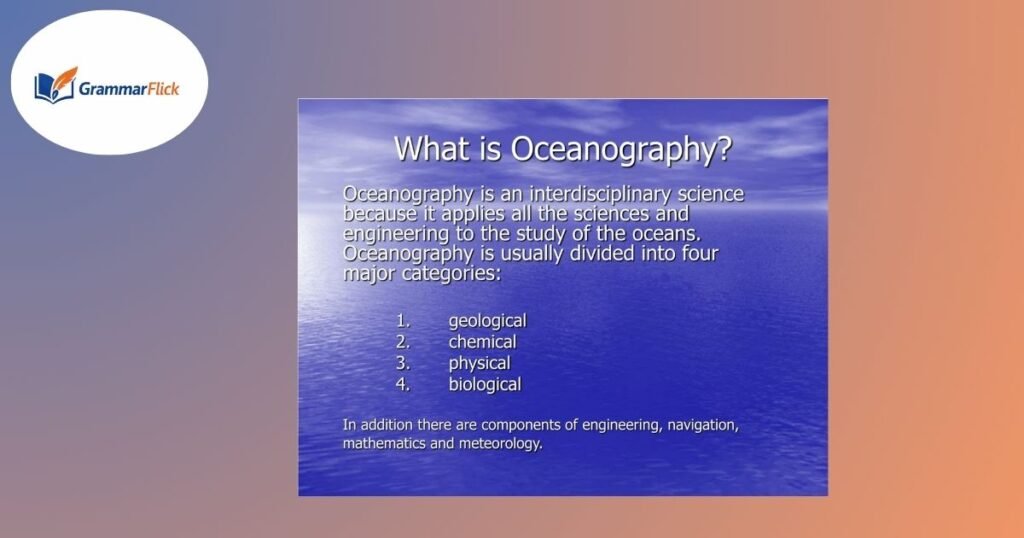
Oceanography also examines marine life, from microscopic plankton to large whales, and investigates issues like pollution and climate change. This field is essential for protecting marine biodiversity, managing natural resources, and predicting environmental changes. By studying oceans, scientists gain insights into one of the largest and most important systems that sustain life on Earth.
Optics
Optics is a branch of physics that focuses on the study of light, its properties, and how it interacts with matter. It explains phenomena such as reflection, refraction, diffraction, and the formation of images.
Optics is used in everyday technologies like eyeglasses, cameras, microscopes, and lasers. It also plays a crucial role in scientific research, allowing scientists to observe very small objects and distant stars. Understanding optics has led to major advancements in medicine, communication, and engineering, making it one of the most important fields in modern science and technology.
Orbitals
Orbitals are regions around an atom’s nucleus where electrons are most likely to be found. These regions are not fixed paths but probability zones that describe the behavior and energy levels of electrons. Orbitals come in different shapes and types, such as s, p, d, and f, each with specific characteristics. They play a key role in determining how atoms bond and form molecules.
Ovoviviparous
Ovoviviparous animals are those whose eggs develop inside the mother’s body, but the young are born alive rather than being laid as eggs. The embryos receive nourishment from the egg yolk instead of a placenta, which distinguishes them from true live-bearing (viviparous) animals.
This reproductive strategy protects the developing offspring while still relying on internal egg development. Examples include some species of sharks, snakes, and fish. Ovoviviparity is an interesting evolutionary adaptation that increases the chances of survival in certain environments where external egg development may be risky.
Organic Chemistry
Organic chemistry is the branch of chemistry that studies carbon-containing compounds and their structures, properties, and reactions. It focuses on molecules such as hydrocarbons, alcohols, proteins, and DNA, which are essential to life. Organic chemistry plays a major role in industries like medicine, agriculture, and manufacturing, as it helps in the development of drugs, plastics, and fuels.
Oxytocin
Oxytocin is a hormone produced in the hypothalamus and released by the pituitary gland, often referred to as the “love hormone.” It plays a key role in social bonding, trust, and emotional connection between individuals.
Oxytocin is especially important during childbirth, as it helps stimulate contractions, and during breastfeeding, where it aids milk release. It is also released during positive social interactions like hugging or spending time with loved ones. This hormone influences human behavior and emotional well-being, making it an important subject in both biology and psychology.
Read More: Snowball Kiss Meaning in Text: Understanding the Slang Term
Oligotrophic
Oligotrophic refers to environments, particularly lakes and oceans, that are low in nutrients such as nitrogen and phosphorus. These ecosystems typically have clear water, low algae growth, and high oxygen levels. Because of the limited nutrients, oligotrophic environments support fewer organisms compared to nutrient-rich (eutrophic) systems.
They often host specialized species adapted to these conditions. Studying oligotrophic ecosystems helps scientists understand nutrient cycles, water quality, and environmental changes, especially in the context of pollution and climate change.
Oscillation
Oscillation is the repeated back-and-forth motion of an object or system around an equilibrium point. It is a fundamental concept in physics and can be observed in systems like a swinging pendulum, vibrating strings, or sound waves. Oscillations can be regular and periodic, meaning they repeat in a consistent pattern over time.
This concept is important in many scientific and engineering applications, including electronics, acoustics, and wave mechanics. Understanding oscillation helps explain how energy moves through systems and is essential for designing stable and efficient technologies.
Final Words
Science words that start with “O” highlight the diversity and depth of scientific knowledge across multiple fields. From fundamental concepts like oxygen and orbit to specialized terms such as oligotrophic and ovoviviparous, these words help explain how the natural world functions. They connect biology, chemistry, physics, and environmental science, showing how different disciplines are interrelated.
Learning these terms not only improves scientific vocabulary but also enhances understanding of real-world processes. Whether studying life, matter, or the universe, mastering such terminology builds a strong foundation for curiosity, critical thinking, and further exploration in science.
FAQs
Why Is It Important to Learn Science Words Starting With O?
Learning these words helps improve understanding of key scientific concepts and builds a strong vocabulary for studying different branches of science.
Are Science Words Starting with O Used in Everyday Life?
Yes, the science terms start with o like oxygen, orbit, and optics are commonly used in daily life, education, and technology, making them highly relevant.