Wonderful World of Science Words That Start With W: A Complete Guide
The letter “W” may not seem as common in scientific vocabulary as letters like “S” or “C,” but it still introduces many important concepts. These words help describe natural forces, biological processes, chemical interactions, and environmental systems. Science is filled with fascinating terms that help us understand the universe, from the tiniest particles to the vastness of space.
Among these, science words that start with the letter W cover a wide range of topics in physics, biology, chemistry, astronomy, and environmental science. In this in-depth guide, we’ll explore these “W” words, explain their meanings in simple language, and show how they connect to real-world science.
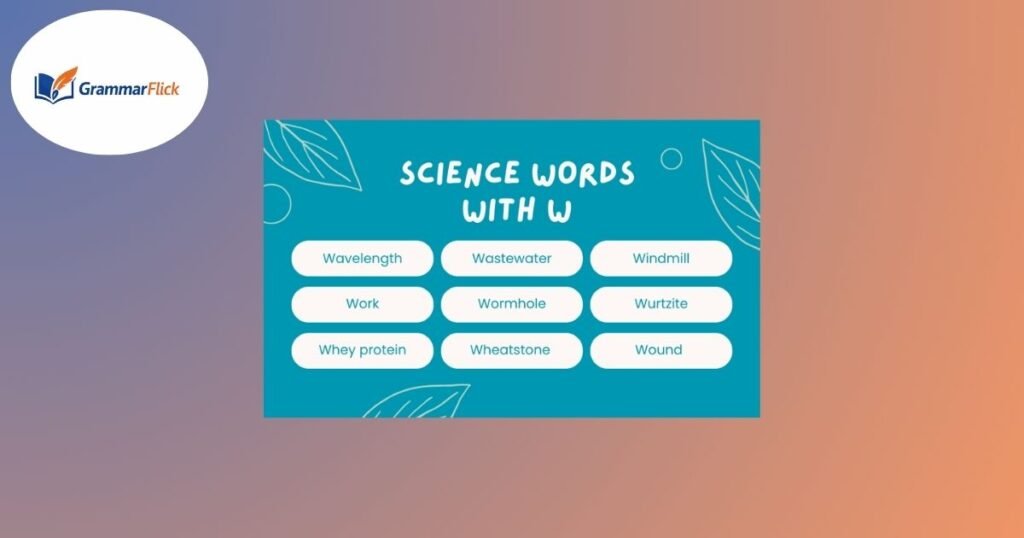
List of Science Words That Start with w
- Wave
- Wavelength
- Weather
- Water Cycle
- Work (Physics)
- Watt
- Wind
- Wildlife
- Wetlands
- White Blood Cells
Wave
A wave is a way energy travels through space or a medium without permanently moving the matter itself. Waves can be seen in water, sound, and even light. For example, ocean waves move across the surface, while sound waves travel through air to reach our ears.
There are two main types: mechanical waves, which need a medium like water or air, and electromagnetic waves, which can travel through space. Waves are important in science because they help explain how energy moves, how we hear sounds, and how technologies like radio, television, and mobile communication work.
Wavelength
Wavelength is the distance between two repeating points of a wave, such as from one crest to the next. It is usually measured in meters and is a key property of waves. In light waves, wavelength determines color. Shorter wavelengths appear blue or violet, while longer wavelengths appear red.
In sound waves, wavelength affects pitch, with longer wavelengths producing lower sounds. Wavelength is closely related to frequency and energy, making it essential in physics and communication systems. Understanding wavelength helps scientists develop technologies like lasers, radios, and medical imaging tools used in hospitals.
Weather
Weather refers to the day-to-day conditions of the atmosphere in a specific place, including temperature, humidity, wind, and rainfall. It can change quickly and varies from one location to another.
Weather is studied by meteorologists who use satellites, radar, and computer models to make forecasts. These predictions help people plan daily activities and prepare for extreme conditions like storms or heatwaves. Weather also affects agriculture, transportation, and human health.
Water Cycle
The water cycle is the continuous movement of water on, above, and below the surface of the Earth. It includes key processes such as evaporation, where water turns into vapor due to heat, condensation, where vapor cools and forms clouds, and precipitation, where water falls back to Earth as rain, snow, or hail.
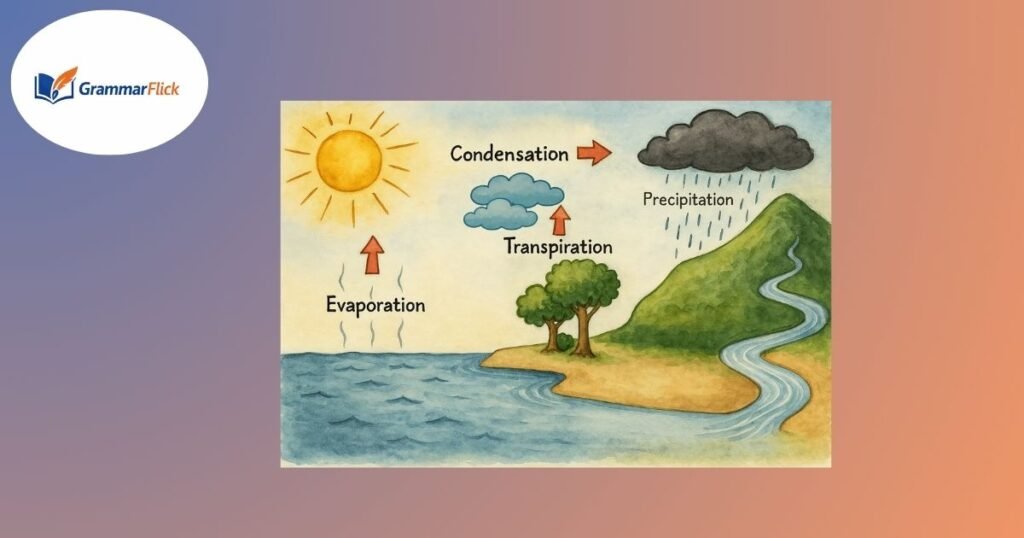
Water collects in rivers, lakes, and oceans, ready to begin the cycle again. This natural system is essential for life because it distributes fresh water across the planet, supports ecosystems, and helps regulate Earth’s temperature and climate patterns.
Work (Physics)
In physics, work is done when a force is applied to an object and causes it to move in the direction of the force. It is calculated by multiplying the force by the distance moved. Work helps explain how energy is transferred from one object to another.
For example, lifting a box or pushing a cart involves doing work. If there is no movement, no work is done, even if force is applied. This concept is important in understanding machines, engines, and everyday physical activities, making it a fundamental idea in mechanics and energy studies.
Watt
A watt is a unit of power that measures how quickly energy is used or transferred. It is named after the inventor James Watt, who contributed to the development of the steam engine. One watt represents one joule of energy used per second. Watts are commonly used to describe the power of electrical devices like light bulbs, fans, and appliances.
Wind
Wind is the movement of air from areas of high pressure to areas of low pressure in the Earth’s atmosphere. It is caused mainly by the uneven heating of the Earth’s surface by the sun. Wind plays a major role in shaping weather patterns, distributing heat around the planet, and influencing ocean currents.
It is also an important source of renewable energy, as wind turbines convert wind power into electricity. Additionally, wind helps in natural processes such as pollination and seed dispersal, making it essential for maintaining ecological balance.
Read More: Outstanding Science Words That Start With O: A Complete Exploration of Key Terms and Concepts
Wildlife
Wildlife refers to all living organisms that exist in their natural habitats without human domestication, including animals, plants, fungi, and microorganisms. It plays a crucial role in maintaining ecological balance and biodiversity. Wildlife contributes to food chains, supports ecosystems, and helps regulate natural processes like pollination and decomposition.
Scientists study wildlife to understand behavior, conservation needs, and environmental changes. Protecting wildlife is important because many species are threatened by habitat loss, climate change, and human activities, which can disrupt entire ecosystems.
Wetlands
Wetlands are areas of land that are saturated with water either permanently or seasonally, such as marshes, swamps, and bogs. They are among the most productive ecosystems on Earth. Wetlands act as natural filters by removing pollutants from water, help control floods by absorbing excess rainwater, and provide habitats for a wide variety of plants and animals.
They also play a role in maintaining water quality and supporting biodiversity. Due to their environmental importance, wetlands are often protected and conserved to sustain ecological health.
White Blood Cells
Wetlands are areas of land that are saturated with water either permanently or seasonally, such as marshes, swamps, and bogs. They are among the most productive ecosystems on Earth. Wetlands act as natural filters by removing pollutants from water, help control floods by absorbing excess rainwater, and provide habitats for a wide variety of plants and animals.
They also play a role in maintaining water quality and supporting biodiversity. Due to their environmental importance, wetlands are often protected and conserved to sustain ecological health.
Final Words
Science words that start with the letter “W” highlight the diversity and depth of scientific knowledge across many fields. From natural processes like the water cycle and weather to physical concepts such as work and watt, these terms help explain how the world functions.
They are not only important in academic learning but also in everyday life, influencing technology, health, and environmental awareness. Understanding these words makes science more accessible and meaningful, allowing us to better appreciate the systems that support life and the innovations that shape our future.
FAQs
Why Should Students Learn Science Words Starting with W?
Learning these terms improves scientific vocabulary and helps students understand key concepts in physics, biology, and environmental science more clearly.
Which Science Word Starting with W is Most Important?
There is no single most important word, but commonly used ones like water, weather, and work are essential because they relate directly to everyday life and basic scientific understanding.