
X-Factor Science: Powerful Science Words That Start With X
Science words that start with X are rare but very interesting. These words are used in biology, chemistry, physics, medicine, and technology. Terms like X-ray, xenon, and xylem play an important role in scientific studies and everyday life. X-related scientific words help explain topics such as plant systems, medical imaging, and chemical elements.
Students, researchers, and science enthusiasts often explore these unique terms to expand their scientific vocabulary and deepen their understanding. Learning science words beginning with X can also make science more exciting because these uncommon words are linked with advanced discoveries, innovation, and important scientific processes used around the world today.
Science words that start with X
- Xenobiology
- Xenogenesis
- Xenon
- Xylose
- X-ray astronomy
- X-ray crystallography
- Xenopsychology
- Xerophyte
- X-chromosome
- Xenotransplatation
- Xenolith
- Xenobiotic
Xenobiology
Xenobiology is a branch of synthetic biology that studies biological systems not found in nature. Scientists design organisms with alternative genetic codes, unusual amino acids, or synthetic DNA bases. These engineered life forms help researchers explore the limits of biology and develop safer biotechnologies because xenobiological organisms cannot survive outside controlled environments.
Xenobiology also supports astrobiology by modeling how life might evolve on other planets. By expanding the definition of life, xenobiology challenges traditional biological assumptions and opens new possibilities for medicine, environmental cleanup, and bio‑manufacturing. It represents one of the boldest frontiers in modern science.
Xenogenesis
Xenogenesis refers to the creation of offspring that differ significantly from their parents, often appearing as if they belong to another species. While true xenogenesis does not occur naturally in humans or animals, the concept is used in genetics, evolutionary biology, and speculative science.
In modern research, xenogenesis is sometimes discussed in relation to gene editing, hybrid organisms, and developmental anomalies. It also appears in science fiction to explore themes of mutation and alien life. Although rare in real biology, xenogenesis helps scientists think about genetic variation, evolutionary change, and the boundaries of heredity.
Xenon
Xenon is a noble gas known for its stability and unique properties. It is used in high‑intensity lamps, spacecraft ion propulsion systems, and medical imaging technologies such as xenon‑enhanced CT scans. Xenon’s ability to dissolve in lipids makes it useful as an anesthetic, offering a rapid onset and recovery.
In physics, xenon detectors help search for dark matter because the gas produces measurable light when struck by particles. Despite being rare in Earth’s atmosphere, xenon plays an outsized role in modern science and technology, demonstrating how even trace elements can have powerful applications.
Xylose
Xylose is a naturally occurring sugar found in the cell walls of plants, especially in hemicellulose. It is a key component in biofuel research because microorganisms can convert xylose into ethanol and other renewable energy sources. Xylose is also used in medical testing to evaluate intestinal absorption.
In food science, it serves as a low‑calorie sweetener with minimal impact on blood sugar levels. Understanding xylose helps scientists improve sustainable energy production, develop healthier food alternatives, and study plant biology. Its versatility makes it an important molecule in both industrial and biological research.
X‑ray Astronomy
X‑ray astronomy studies celestial objects that emit high‑energy X‑rays, such as black holes, neutron stars, and supernova remnants. Because Earth’s atmosphere blocks X‑rays, scientists use space‑based telescopes like Chandra and XMM‑Newton to observe these energetic phenomena.
X‑ray astronomy reveals extreme environments where matter reaches millions of degrees and gravity warps space‑time. It helps researchers understand stellar evolution, galaxy formation, and the behavior of dark matter. By capturing invisible radiation, X‑ray astronomy provides a deeper view of the universe’s most violent and mysterious processes, expanding our understanding of cosmic physics.
X‑ray Crystallography
X‑ray crystallography is a technique used to determine the atomic structure of crystals by analyzing how X‑rays scatter when they pass through them. This method has been essential in discovering the double‑helix structure of DNA, mapping proteins, and designing pharmaceuticals.
Scientists use crystallography to understand how molecules interact, fold, and function. The technique requires precise crystal formation and advanced computational analysis. X‑ray crystallography continues to drive breakthroughs in chemistry, biology, and materials science, enabling researchers to visualize structures at the atomic level and develop targeted medical treatments.
Xenopsychology
Xenopsychology is the theoretical study of the psychology of extraterrestrial life. Although no alien species have been discovered, scientists and philosophers use xenopsychology to explore how non‑human intelligence might think, communicate, or behave. The field intersects with astrobiology, neuroscience, and cognitive science.
It helps researchers prepare for potential contact scenarios and understand the diversity of possible minds in the universe. Xenopsychology also inspires science fiction, shaping how alien species are portrayed in literature and film. While speculative, it encourages deeper reflection on what intelligence means beyond Earth.
Xerophyte
A xerophyte is a plant adapted to survive in extremely dry environments such as deserts. These plants have specialized features like thick cuticles, reduced leaves, deep roots, and water‑storing tissues. Examples include cacti, agave, and certain shrubs. Xerophytes play a crucial role in preventing soil erosion, supporting desert ecosystems, and providing food and medicine in arid regions.
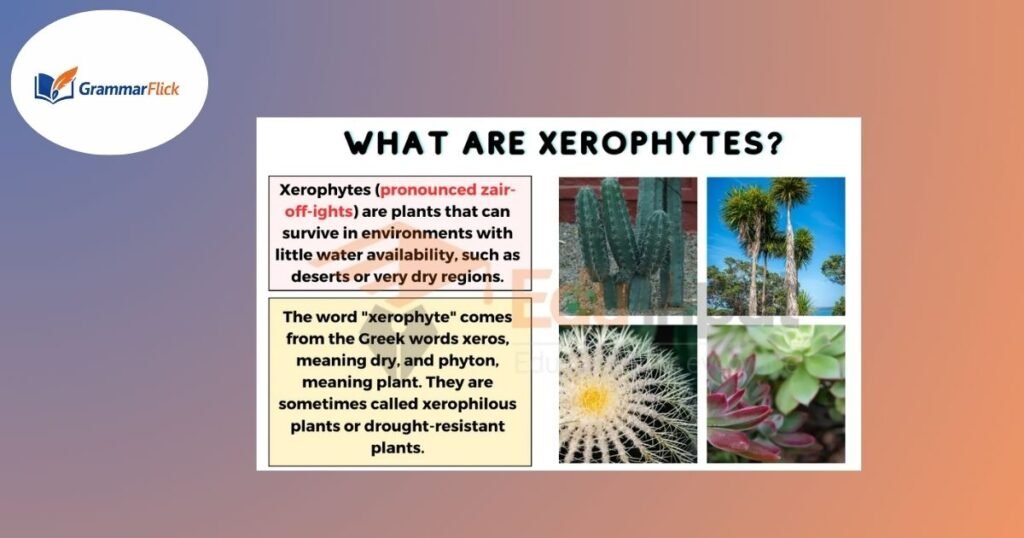
Studying xerophytes helps scientists understand climate adaptation, drought resistance, and sustainable agriculture. As global temperatures rise, research on xerophytes becomes increasingly important for developing crops that can thrive in water‑scarce environments.
X Chromosome
The X chromosome is one of the two sex chromosomes in humans and many other species. It carries over a thousand genes involved in development, immunity, and metabolism. Females typically have two X chromosomes, while males have one X and one Y. X‑linked genetic disorders, such as hemophilia and color blindness, occur when mutations affect genes on this chromosome.
X‑inactivation, a process where one X chromosome in females becomes inactive, ensures balanced gene expression. Understanding the X chromosome is essential for genetics, medicine, and evolutionary biology, revealing how traits are inherited and regulated.
Xenotransplantation
Xenotransplantation involves transplanting organs, tissues, or cells from one species to another, typically from animals to humans. Scientists explore this technique to address organ shortages and save lives. Pigs are the most common donor species because their organs are similar in size to human organs.
Xenotransplantation faces challenges such as immune rejection, viral transmission, and ethical concerns. Advances in gene editing, especially CRISPR, help reduce these risks by modifying donor animals. Xenotransplantation represents a promising but complex frontier in regenerative medicine and transplant science.
Read More: Top Science Words That Start With T: Meaning, Uses, and Importance in Modern Science
Xenolith
A xenolith is a fragment of rock trapped inside another type of rock during volcanic activity. These foreign inclusions provide valuable clues about Earth’s interior because they originate from deep within the mantle or crust. Geologists study xenoliths to understand mineral composition, temperature, pressure, and geological processes occurring beneath the surface.
Xenoliths often contain rare minerals that reveal Earth’s history and tectonic evolution. By analyzing these natural “time capsules,” scientists gain insights into how continents form, how magma evolves, and how Earth’s internal layers interact.
Xenobiotic
A xenobiotic is a chemical substance that is foreign to a living organism. Examples include drugs, pollutants, pesticides, and synthetic compounds. The body processes xenobiotics through metabolic pathways in the liver, converting them into forms that can be excreted.
Studying xenobiotics helps toxicologists understand how chemicals affect health, how long they remain in the body, and how to design safer pharmaceuticals. Environmental scientists also examine xenobiotics to assess pollution and ecosystem health. Understanding xenobiotics is essential for medicine, public health, and environmental protection.
Final words
Science words beginning with X may be rare, but they represent some of the most advanced and imaginative areas of scientific study. From xenobiology and xenotransplantation to xerophytes and X‑ray astronomy, these terms highlight innovation, exploration, and the expanding boundaries of human knowledge. Learning them strengthens scientific vocabulary and opens the door to fascinating fields across biology, chemistry, physics, and astronomy.
FAQs
What X‑Science Word is Most Used in School?
X‑ray is the most commonly taught X‑science word. Students learn about X‑ray imaging, electromagnetic waves, and their uses in medicine and astronomy. You can explore it deeper through X‑ray astronomy or X‑ray crystallography.
What X‑Science Words Relate to Earth Science?
Geology uses xenolith, a rock fragment trapped inside another rock during volcanic activity. This helps scientists study Earth’s mantle and crust. Explore xenoliths for more detail.